The short answer: Use standard configuration when it delivers an acceptable business outcome. Use Odoo Studio for contained changes within its supported toolbox. Integrate when another platform must remain responsible for part of the process or its data. Build a custom module when the requirement represents important business logic that the simpler options cannot express safely and clearly.
This is not an argument against customization. It is a framework for putting each requirement in the right layer and accounting for its full ownership cost. The decision recommendations below are Neyar Solutions guidance; the product facts are linked to Odoo's official version 19 documentation.
The four implementation paths
Standard configuration
Standard configuration covers enabling applications and features and setting up companies, warehouses, sequences, policies, permissions, and application options without introducing new software behavior.
It is usually the right starting point for common requirements that Odoo can already satisfy. It still requires thoughtful process design, data preparation, permission design, testing, and training.
Odoo Studio
Odoo describes Studio as a toolbox for customizing Odoo without coding knowledge. Its documented scope includes fields, views, models, automation rules, webhooks, PDF reports, approval rules, and security rules. Odoo also explains that views are interfaces for displaying model data and that one model can have several views of the same data.
In Neyar Solutions' view, Studio fits contained, understandable changes such as an additional field, a focused screen adjustment, a straightforward approval, or a simple automation. No-code still needs governance: record the owner, purpose, test evidence, and effect on permissions and reports.
Integration
Choose integration when a specialist or established external platform should continue to own a function or dataset. Define the system of record, data direction, matching keys, timing, duplicate handling, failure recovery, monitoring, and ownership on both sides.
That is Neyar Solutions engineering guidance. The cited Studio page confirms webhook support, but it does not establish that every external system can or should be connected by webhook. Each integration needs its own technical assessment.
Custom module
A custom module becomes relevant when the requirement introduces substantial business logic, crosses applications, or needs controls that configuration and Studio cannot represent well. Odoo's developer reference states that __manifest__.py declares a Python package as an Odoo module and provides module metadata. Its depends field names modules that must load first.
That structure makes scope and dependencies explicit, but it does not create quality by itself. Neyar Solutions recommends a defined module scope, source repository, versioning, tests, documentation, maintenance owner, and upgrade plan.
Practical comparison
| Approach | Strong fit | Main concern | Ownership needed | Expected upgrade effort* |
|---|---|---|---|---|
| Standard configuration | Common process supported by Odoo settings | Process adoption, data, training | Configuration record and functional owner | Usually lowest, with process retesting |
| Studio | Contained field, view, approval, or supported automation change | Undocumented accumulation and permission effects | Change log, owner, acceptance test | Low to medium, depending on volume and coupling |
| Integration | External platform remains responsible for a function or data | API change, sync failure, duplication, monitoring | Interface contract, mapping, logs, owners | Medium to high, depending on both systems |
| Custom module | Material, complex, or differentiating business logic | Code quality, security, dependencies, testing | Source, documentation, versions, maintainer | Proportional to scope and coupling with Odoo |
* Comparative Neyar Solutions guidance, not a fixed quote or guaranteed outcome.
Seven questions for a defensible decision
1. Is this a business outcome or a preferred screen design?
Write an acceptance statement first. “Orders above this threshold require approval before confirmation” is more useful than “add an approval button.” Standard Odoo may achieve the outcome through a different interaction.
2. Does the practice differentiate the business?
Do not remove a valuable distinction merely because it is company-specific. Equally, do not reproduce every historical spreadsheet step. Preserve what protects a meaningful advantage or operational control; challenge steps with no clear value.
3. What must be retested at upgrade time?
Count affected applications, views, reports, permissions, and interfaces, not only development hours. Wider touchpoints create a wider potential regression surface.
4. Who owns the result?
The company should know where configuration and source code live, who can access them, how knowledge is transferred, and what happens if a partner or employee changes. Ownership can be contractual; it does not require an entirely internal delivery team.
5. Are security and permissions designed in?
Odoo states that access rights determine what users can access and edit, can be assigned to individuals or groups, and can only be changed by an administrator. Its documentation warns that incorrect changes can harm the database. Test with real user roles, not only an administrator account.
6. Does the hosting model permit the approach?
Odoo's version 19 hosting documentation states that Odoo Online is not compatible with non-standard apps. If a custom module is essential, settle the hosting question before approving development. This fact does not make one hosting model universally best.
7. Can a simpler layer deliver the same value?
Prototype in a test environment and compare usability, permissions, support, and failure behavior. Studio may be sufficient; in other cases, a module or integration may be cleaner over the full lifecycle.
Decision scorecard
Score each statement 0 for low, 1 for medium, or 2 for high.
- The requirement creates differentiation or protects an important control.
- The logic goes beyond a field, view, or simple approval.
- It crosses multiple applications or models.
- It relies on an external system that remains a system of record.
- It needs granular permissions or record rules.
- Failure materially affects operations or financial data.
- The company has an owner and budget for testing, maintenance, and upgrades.
Neyar Solutions interpretation: A low score favors testing standard configuration or Studio first. A middle score calls for a documented prototype comparison. A high score does not automatically mean custom code, but it justifies deeper functional and technical analysis of integration or a custom module.
Approval checklist
- Express the requirement as a testable business outcome.
- Test the standard route before rejecting it.
- Document why Studio, integration, or a module was selected.
- Name the business and technical owners.
- Test permissions with non-admin roles.
- Confirm hosting constraints.
- Define acceptance, failure, and recovery cases.
- Keep configuration, code, versions, and documentation accessible under clear company or contractual ownership.
- Include maintenance and upgrade testing in the estimate.
Conclusion
Good customization is not maximum code. Good implementation is not minimum code at any cost. The goal is the simplest maintainable solution that delivers the required value while preserving the business distinctions worth protecting.
Frequently asked questions
Is Odoo customization always a bad idea?
No. A custom module can be appropriate for core logic or genuine differentiation. The risk comes from unclear scope and missing tests, ownership, and maintenance, not from customization itself.
When should we use Odoo Studio instead of a module?
Evaluate Studio when a contained requirement fits its documented toolbox and remains easy to understand and test. Give a custom module serious consideration when the logic becomes complex or crosses applications.
Is Studio free from upgrade effort?
That should not be assumed. Changes still need documentation and regression testing, with effort depending on their number and coupling. This is Neyar Solutions operational guidance, not a fixed Odoo estimate.
Can custom modules run on Odoo Online?
Odoo's version 19 hosting documentation says Odoo Online is not compatible with non-standard apps. Review hosting before approving a custom module.
How can a company reduce customization risk?
Define the outcome, limit scope, test permissions, retain source and documentation, version the solution, name a maintainer, and budget for upgrade testing.
Call to action
Have a requirements list but no clear boundary between configuration, Studio, integration, and development? Request a business process review with Neyar Solutions to create a decision register covering value, risk, ownership, hosting, and test obligations before approving the implementation scope.
Suggested internal links
- Odoo implementation for Saudi businesses — first implementation reference.
- Odoo customization and integration — integration and module sections.
- Odoo support and continuous improvement — ownership and maintenance section.
- Contact Neyar Solutions — CTA.
External links
- Odoo 19 Studio documentation
- Odoo 19 Studio views documentation
- Odoo 19 access rights documentation
- Odoo 19 hosting documentation
- Odoo 19 module reference
English Schema: Article
{
  "@context": "https://schema.org",
  "@type": "Article",
  "inLanguage": "en-SA",
  "headline": "Standard, Studio, Integration, or Custom Module? Choosing the Right Odoo Approach",
  "description": "A practical framework for choosing between standard Odoo configuration, Studio, integration, and custom modules.",
  "author": {"@type": "Organization", "name": "Neyar Solutions", "url": "https://neyar.net"},
  "publisher": {"@type": "Organization", "name": "Neyar Solutions", "url": "https://neyar.net"},
  "mainEntityOfPage": {"@type": "WebPage", "@id": "https://neyar.net/en/blog/choose-odoo-configuration-studio-integration-module/"}
}
English Schema: FAQPage
{
  "@context": "https://schema.org",
  "@type": "FAQPage",
  "inLanguage": "en-SA",
  "mainEntity": [
    {"@type": "Question", "name": "Is Odoo customization always a bad idea?", "acceptedAnswer": {"@type": "Answer", "text": "No. A custom module can suit core logic or genuine differentiation when scope, testing, ownership, and maintenance are properly defined."}},
    {"@type": "Question", "name": "When should we use Odoo Studio instead of a module?", "acceptedAnswer": {"@type": "Answer", "text": "Evaluate Studio for contained changes within its documented toolbox; compare a maintained module when logic is complex or crosses applications."}},
    {"@type": "Question", "name": "Can custom modules run on Odoo Online?", "acceptedAnswer": {"@type": "Answer", "text": "Odoo 19 documentation states that Odoo Online is not compatible with non-standard apps, so hosting should be reviewed before approving a custom module."}}
  ]
}
Featured Image Brief
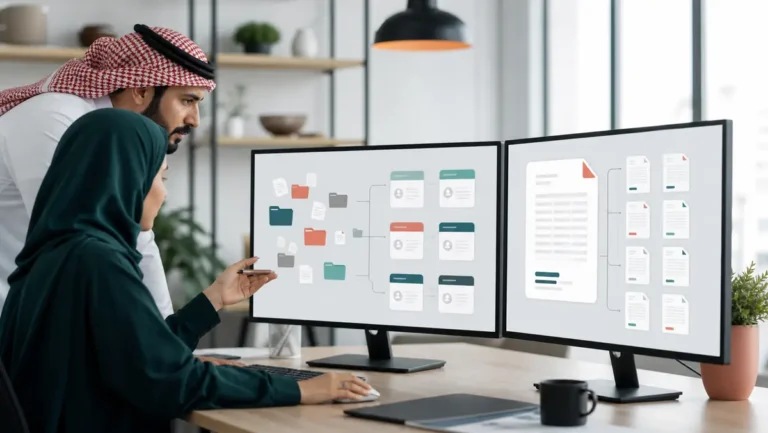
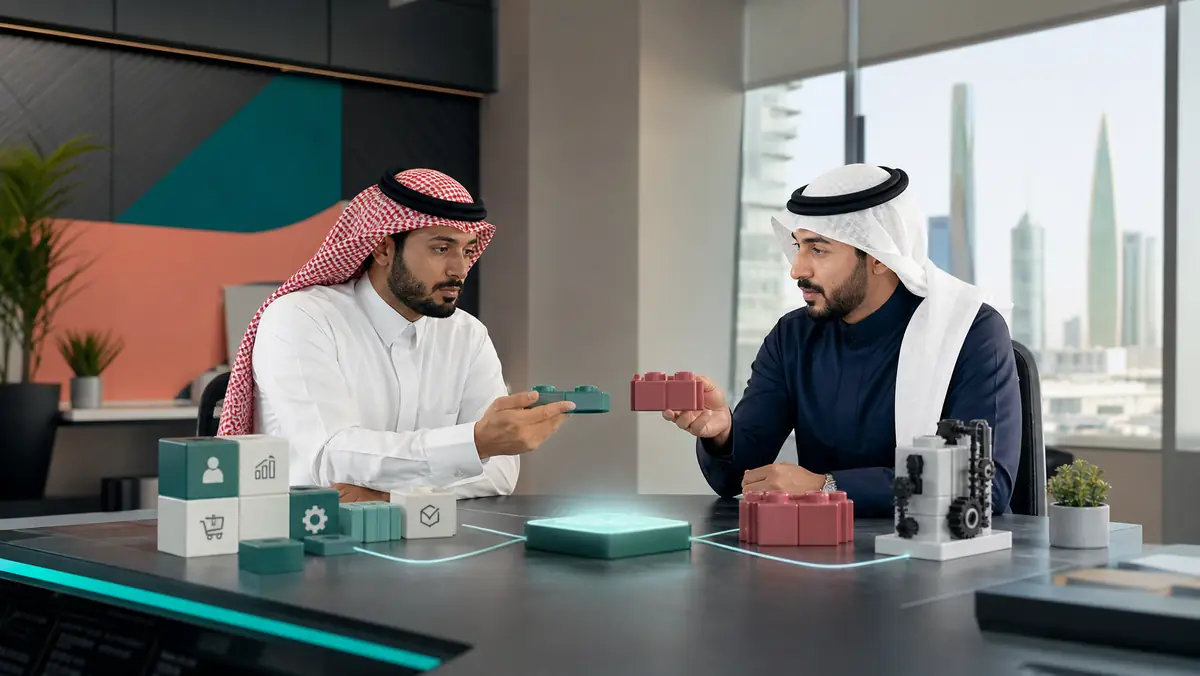
- Concept: A Saudi operations leadership meeting reviewing one Odoo requirement on a large screen. The screen shows four clearly separated routes: Standard, Studio, Integration, and Custom Module, converging into one decision record. Use a realistic modern Riyadh office and a balanced mixed-gender Saudi business team; the visual should communicate evaluation and ownership, not generic software coding.
- Composition: 16:9, 1200 × 675 px. People on the right third, decision matrix on the left and center. Keep 10% safe margins and leave a clean upper-left area for an editable Arabic headline overlay.
- Overlay text (editable, not AI-rendered):
قياسي، Studio، ربط، أم تطوير مخصص؟ - English overlay variant:
Standard, Studio, Integration, or Custom? - Brand treatment: Neyar Solutions logo in the lower-right safe area; restrained brand colors with neutral office tones. No Odoo logo unless brand-use approval is confirmed.
- Alt text AR: فريق إدارة سعودي يقارن بين الإعداد القياسي وStudio والربط والتطوير المخصص في Odoo.
- Alt text EN: Saudi management team comparing standard configuration, Studio, integration, and custom module options in Odoo.
- Avoid: Futuristic holograms, code-filled screens, binary good-versus-bad imagery, guarantees, cost percentages, distorted Arabic text, or an image implying that customization is inherently unsafe.
- Generation status: Brief prepared; no image generated in this package.